IBM 5150 Launch 45 Years Ago: How the PC Took Over the Market
In the early 1980s, IBM faced an uncomfortable reality: “big computers” weren’t the only game in town anymore. As cheaper microcomputers from Apple, Atari, Commodore, and Sinclair found their way into homes and small offices, IBM had to move fast—or risk watching the market shift underneath it. The result was the machine that helped define what “PC” would mean for decades: the IBM 5150, launched in August 1981.
Why IBM needed a new direction
Before the 1980s, “computer” meant large, shared mainframe systems used by entire organizations. IBM was one of the leading names in that world, but the company’s in-house attempts at smaller devices couldn’t match the low prices of emerging personal and office computers. IBM’s System/32 and the portable 5100—both from 1975—were simply too expensive to compete with mass-market micros.
Those external competitors were already establishing clear price benchmarks. Apple’s Apple II arrived in 1977, while Atari’s 400 launched in 1977 and the XL line followed in 1982. Commodore sold the PET in 1977 and introduced the VC80 in 1980. Sinclair’s ZX80 debuted in 1980 and its Spectrum arrived in 1982. By the time IBM was making its decision, these “desk-ready” machines were priced far below what most households could justify for IBM’s earlier efforts.
The contrast in cost was stark. The 5100 reportedly reached up to 20,000 US dollars, while a spreadsheet-capable Apple II from 1977 sat around 1,300 to 2,700 US dollars. By 1983, the Apple IIe—bundled with a monitor and accessories—had dropped to under 2,000 US dollars.
Project Chess: building a PC fast for mass production
To respond, IBM set up a team under the internal codename “Project Chess.” Unlike IBM’s traditional approach, the project was allowed to break from corporate norms in several key ways: it could rely on third-party software and parts, avoid compatibility with existing IBM systems, and build in a style reminiscent of Apple’s direction. The guiding goals were speed and manufacturability at scale—so the finished product could be produced cheaply in large quantities.
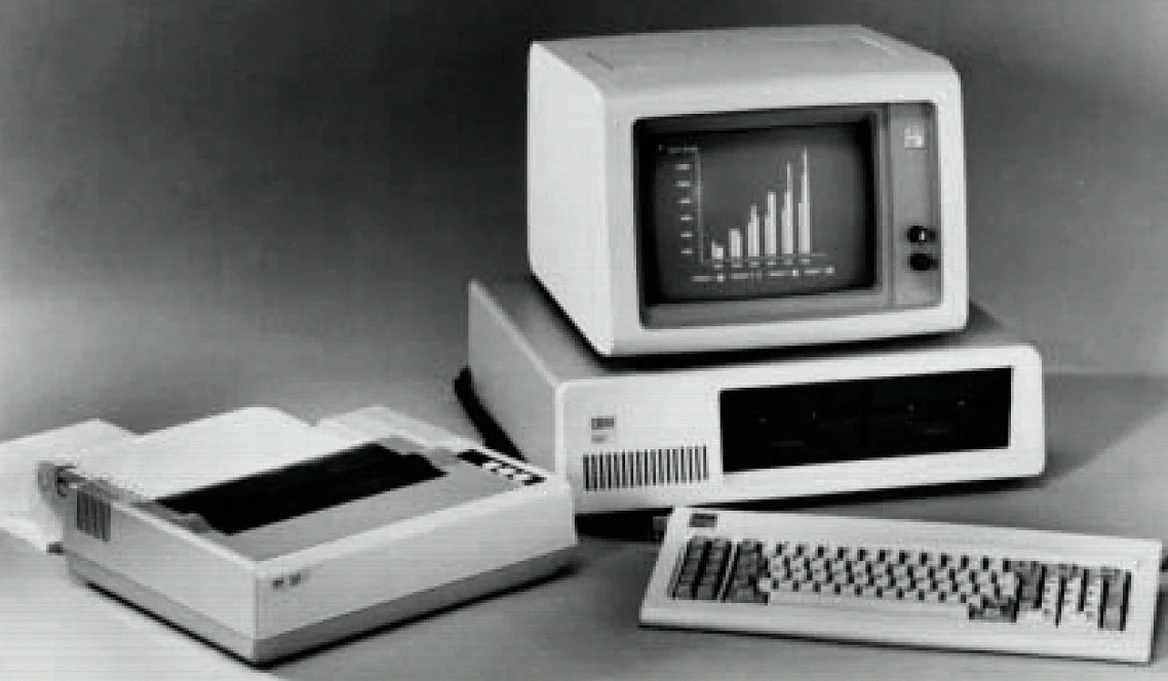
That plan landed quickly. On 12 August 1981, IBM released the “Model 5150,” marketed as the “IBM PC.” The base price was 1,600 US dollars.
By the time buyers added a monitor, floppy disk drives, and a higher-quality keyboard, the total came closer to 3,000 US dollars—still positioned as a strong value for a complete business workstation in 1981.
What the original IBM PC actually offered
The term “personal computer” had already been in use for more than half a decade, but the IBM PC was the first device sold as a “PC,” and it would go on to shape the IT world in a way that no earlier system did. Its specifications weren’t universally cutting-edge, but the overall package was practical—and importantly, it was expandable.
-
Memory: 16 to 64 KiB of RAM.
-
CPU: an Intel 8088, described as a cost-reduced version of the 8086 that had been used in microcomputers for about three years.
-
Video: a “Monochrome Display Adapter” that supported text but not graphics, and not color.
-
Storage: a standard cassette recorder connection for data storage.
-
Firmware and software: 32 KiB of internal ROM containing a BASIC interpreter.
-
Operating system: IBM PC DOS at launch, which was a branded version of Microsoft’s MS-DOS. That MS-DOS lineage traced back to Seattle Computer’s 86-DOS.
Expansion was the real lever
The IBM PC’s success wasn’t only about its initial specs. It was built to grow. That modular approach helped create a durable ecosystem for upgrades and third-party support.
-
Front bays for two full-height 5.25-inch disk drives, with double the height of the slots that later became common.
-
Five expansion slots on the motherboard.
-
Support for up to 640 KiB RAM using larger DRAM chips over time.
-
Early graphics options tailored for different use cases.
-
Typical business configurations shipped with a floppy controller and one or two drives.
Each floppy disk held 160 KiB per side, a capacity comparable to today’s smallest cache concepts—but enough to standardize software distribution. Soon after launch, hard drive solutions were also being developed for the platform.
Floating-point upgrades and the system bus
If you needed faster floating-point calculations, the IBM PC could be expanded with a floating-point processor installed in a yellow-marked socket. The 8088 CPU was the baseline, but the platform’s design allowed additional chips and expansion to connect through its system bus.
The DRAM chips sat directly on the mainboard, and the expansion slots had more spacing than what became typical later. Although the slot design was formally proprietary, documentation was detailed enough that compatible add-ons became mass-produced well before the (8-bit) ISA standard was finalized toward the end of the 1980s.
How IBM’s choices backfired
Behind the scenes, IBM’s leadership was confident to the point of arrogance. On one hand, IBM didn’t just buy key components from suppliers—it required them to license designs so backup sources could exist. AMD’s early history is mentioned as an example of a CPU supplier starting with official copies of Intel chips, but it wasn’t the only case.
On the other hand, IBM did not secure exclusive supplier agreements. The company treated the computer as a complete system that IBM itself should sell, while valuing only the BIOS code. Everything else was viewed internally as replaceable commodity parts.
The rise of “IBM compatible” PCs
At first, IBM’s plan looked like it would dominate. Sales exceeded expectations dramatically. In 1983 alone, IBM reportedly sold 750,000 units—more than three times the total number of computers IBM had running in 1980. Apple’s earlier PC pioneer revenue was later surpassed by a factor of 2, and both software and hardware for the IBM PC became a huge market—supported by IBM’s strong documentation of interfaces and functions.
But those same conditions helped competitors. As early as 1982, Compaq managed to build a largely IBM-compatible BIOS. Then Phoenix and Award reverse-engineered the original development process to offer clone BIOS solutions starting in 1984. Because IBM had ensured that other components were available from major suppliers like Intel and Microsoft-related partners, more manufacturers could build PC-compatible machines at far lower prices than IBM itself.
Within a few years, this “clone army” overwhelmed other formats. The market landscape shrank into two categories: PC-compatible systems, and a narrowing Apple presence. As the x86 DOS software ecosystem grew large enough, it became difficult for new hardware or firmware platforms to offer competitive features. Over time, even games followed the mass-market advantage of the PC line.
Where the story goes next
IBM itself later sold the PC division to Lenovo in 2005. It also marked the 30-year point of the PC as the company saw it, arguing the era would end as smartphones and tablets took over. Still, even with that prediction in the background, the “PC” label and its compatibility legacy endured.
Key reasons the IBM PC became the standard
-
IBM’s scale and availability made it the first microcomputer that was simultaneously affordable, high quality, and widely distributed.
-
The modular design supported many different workplace needs, which helped sustain a continuous market for software developers.
-
Strong documentation and the availability of components made it possible—after BIOS copyright protection was overcome—to produce many compatible imitation systems. That created a widely used compatibility standard without anyone needing to formally specify it up front.