Dark Deeds Review: A Grimdark, Nostalgia-Fueled Treat for Warhammer Fans
I first fell into Warhammer 40,000 a few months after starting high school back in 2000. A lot of that affection is obviously tied up in nostalgia, but it’s also true that many long-running hobbyists remember the early 2000s with a special kind of warmth. The rules felt crisp and focused, and the setting’s “grim but not humorless” tone hit a fun sweet spot.
Plenty of talented designers, sculptors, writers, and artists helped shape that era, but they were all working under the direction of ’40k Overfiend’ Andy Chambers. So when a PR message landed in my inbox about a re-release of Dark Deeds—a tabletop game Chambers co-designed years after he left Warhammer and his previous work with Games Workshop—I was immediately interested.
Set in a stylized old-English city that feels like Terry Pratchett wrote Mordheim, Dark Deeds is a competitive tabletop game for two to five players. The objective is simple: earn the most favour from your dark god. You do that by robbing citizens, killing guards, and completing randomly drawn “Dark Deed” quest cards.
Of course, each act raises your profile. The more you commit, the more suspicion your character draws from the authorities. The real tension is balancing the need to grow your power and options through loot with the need to disrupt your opponents using clever, nasty plot plays.
After spending time with it, I can say without hesitation: Dark Deeds is genuinely a blast.
We’re off to merrily do some crimes
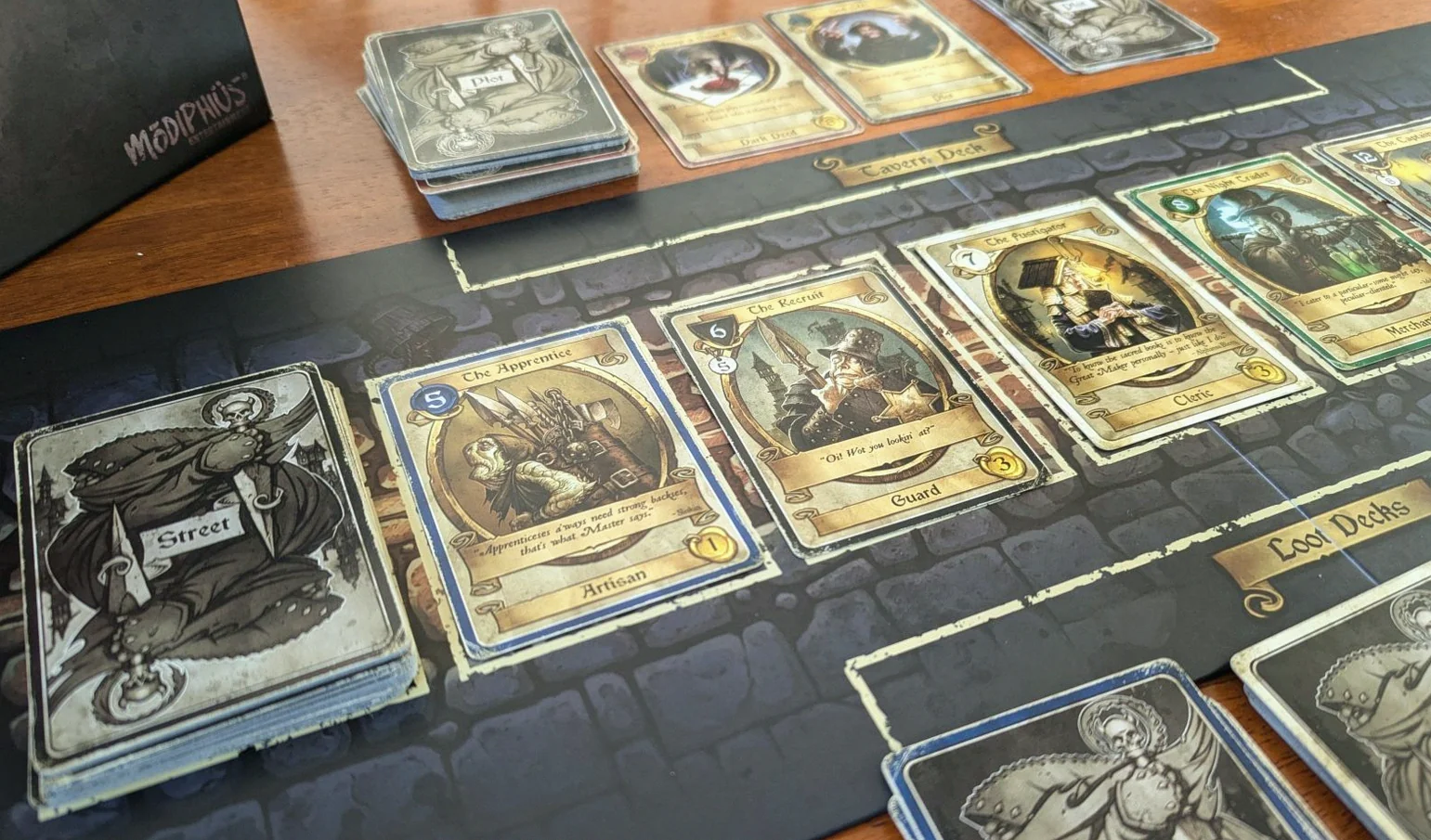
The Dark Deeds board is organized into three main areas. The Tavern is where you acquire Plot cards (which manipulate play) and Dark Deed cards (which act like quests). The Street is where Citizen, Guard, and Nemesis cards move and become targets for players. Finally, there’s the Loot Decks space, which holds three piles of treasure cards. Each pile lines up with one of the three different types of Citizen you can rob.
At the start of the game, every player receives two Dark Deed cards and three Plot cards at random. The remaining cards are shuffled together to create the Tavern deck. After that, the top two cards are drawn and placed beside the Tavern area.
The Street deck contains all Citizen, Guard, and Nemesis cards. From this deck, six cards are drawn and arranged in a row next to the deck itself, representing the targets available on a player’s turn. Each card—along with the Dark Deed cards—includes a “Favour” figure in the bottom-right corner, indicating how many victory points that card is worth by the end of the game.
That same Favour number also ties directly into Suspicion: it determines how many Suspicion tokens a player gains when they successfully rob or murder. As the game progresses, the player holding the most Suspicion at any moment becomes the most “attracting heat” target for the city’s response.
Strategic skullduggery
Each player turn in Dark Deeds is divided into three phases. Phase one is “hit the street.” Here, you select one target from the lineup and attempt to take them down. You must always enter the Street from the right, and you can only engage with a single card during this action.
If your plan is to rob a Citizen and draw a loot card from that Citizen’s matching treasure pile, you first have to sneak past any Guards blocking your path. You do this by rolling higher than the Guard’s Perception value shown on the card.
If instead you want your one target action to be an attempted murder of a Guard or Nemesis, you roll above that card’s Defence value.
A failed attack on a Guard triggers immediate consequences: the Guard will chase you and you gain one additional Suspicion token. While a Guard is chasing you, it also acts as a hurdle—your character can’t even hit the Street until that chase is dealt with. You must sneak past or murder that Guard using the same basic approaches as if it were part of the Street lineup.
There’s no stated cap on how many Guards can chase you at once, but the game includes Dark Deed cards that score you points when multiple Guards are chasing you simultaneously.
Phase two is “visit the tavern.” During this phase, you get one of two options: reduce your Suspicion by rolling 1D6, or take a Plot card or a Dark Deed card from the Tavern area. You can hold up to six of these cards at a time, and you can never discard a Dark Deed card.
Phase three is “take stock.” If you arrive at this stage with 10 or more Suspicion while you are also being chased, you get arrested. When arrested, you lose all of your Loot cards, all of your Suspicion tokens, and you also remove yourself from any Guards currently pursuing you.
After your turn ends, the entire Street row slides to the right, with new cards filling any gaps from the Street deck. If the card that ends up in the far-right position is a Citizen, it’s discarded. If it’s a Guard, it begins chasing the player who currently has the highest Suspicion. If it’s a Nemesis, it chases the player whose turn is ending at that moment. This shifting structure keeps the Street in motion while also giving players regular chances to pressure opponents by redirecting the city’s attention at them.
Plot cards can be used once per phase of your turn, meaning you can set up combos and mischief throughout the cycle. Some Plot cards even work like Instants in Magic: The Gathering, letting them be played at any time by anyone. It’s devilishly fun throughout.
However…
With three players, a game of Dark Deeds tends to take about an hour. Because of how the endgame condition triggers, moving up to four or five players shouldn’t significantly extend the length.
For our group, the rules clicked quickly—after the first turn, we were already enjoying ourselves. Still, there are two main issues I felt worth noting.
First, the Dark Deeds rulebook can feel a bit cumbersome, and since this is a re-release, it’s the kind of thing you’d expect to be explained more clearly.
Second, the game’s structure can sometimes lead to a player getting boxed in by Guards they are forced to deal with—before they’ve collected enough Loot to handle the problem efficiently. This doesn’t break the game, especially given the number of ways you can earn Favour points, but it was frustrating to spend large stretches of the game with fewer practical options open during many “hit the street” phases.
May your patron smile upon you, you right bastard
Dark Deeds is a strong match of tone and mechanics. My friends and I had a great time using the people of the Street against one another with Plot-driven interference, and I have no doubt we’ll be returning to this game repeatedly in the months and years ahead.
It’s also a real pleasure to be enjoying a tabletop game from Mr. Chambers more than twenty years after I first connected with his design sensibilities and brand of humour. It feels like an unexpected gift from the dark powers above.
Dark Deeds
Designers: Andy Chambers, Mark Gibbons, Ryan Miller
Publisher(s): Rookery Publications, Modiphius Entertainment
GamesHub reviews were previously rated on a five-point scale. As of 29 July 2024, they have been rated on a ten-point scale.
Jam Walker is a games and entertainment journalist from Melbourne, Australia. They hold a bachelor’s degree in game design from RMIT, though they jokingly suggest they may have been better off choosing journalism instead. They talk about wrestling online at @Jamwa.
- Dark Deeds
- Modiphius
- Rookery Publications
- Related News
- Trending News
Categories
Latest News
Bandai Namco is coming off the back of EVO 2026, sharing plenty of updates for Tekken 8 Season 3. It reveals Bob as the second playable character of the season…