Brian Azzarello and Eduardo Risso’s La madre de los hermanos Blood Bundle Review
Brian Azzarello and Eduardo Risso, the creative duo behind acclaimed crime and horror-tinged comics, are stepping into a different kind of frontier: a brutal, pessimistic western now being released in a bundled edition. “La madre de los hermanos Blood” arrives as a complete collection that originally ran as four installments, bringing together an unforgiving story of bounty hunters, abandoned children, and a mother whose choices feel more like chaos than villainy.
A noir powerhouse turns to a savage western
Norma Editorial is publishing “La madre de los hermanos Blood,” a graphic narrative that expands Azzarello and Risso’s range beyond the noir reputation that helped define their legacy. The book collects work that first appeared in four separate parts under the DSTLRY label, now gathered into an integral hardcover edition.
The release is scheduled for May 15, 2026. The hardcover edition is listed at 224 pages, with ISBN 978-84-679-8329-6, published by Norma Editorial.
A tale of pursuit, survival, and moral collapse
Set in a western world far from romantic heroics, the series centers on characters who are ready to kill for small rewards and who treat morality as disposable. The story is driven by two interlocking plotlines.
-
Carter, a hardened gunslinger, begins a new life after spending five years in prison, turning his skills toward bounty hunting. Before he fully settles into that role, he chooses to settle a personal score with Anna—his former lover—who has since married a reverend and is raising three children.
-
Three abandoned children are forced to cross a vast, hostile landscape in search of their mother. Their journey is defined by misfortune and the loss of innocence as each encounter exposes them to a world without mercy.
While the premise echoes classic western themes of family reunion, Azzarello flips the expected outcome. The children’s progress is not a straightforward march toward rescue. Instead, their trail points toward Anna—an individual who may be more dangerous than the outlaws they meet along the way.
Anna as the story’s true engine
Anna stands out as the most compelling presence in the comic’s cast. In a society where power dynamics are harsh and life is treated as cheap, she refuses to hesitate when someone blocks her path—even when those obstacles include her own children. Yet she doesn’t behave like a traditional comic-book villain pursuing a single, clear goal.
Her unpredictability gives the book much of its dramatic momentum. Anna functions less like a character confined to a plan and more like an uncontrollable force—one that the world around her can’t fully understand or predict.
Fatalism, frontier archetypes, and contemporary reshuffling
The comic’s bleak tone evokes a broader literary mood tied to the frontier’s darkness, with the narrative sharing a similar sense of inevitability and recurring types: bounty hunters, reverends, outlaws, and towns that survive outside any real law. Azzarello also incorporates familiar western building blocks such as new territory expansion, gold fever, conflicts with Native communities, and banditry—then reorganizes them through a more personal, modern lens.
The result fits the spirit of DSTLRY, a label known for author-driven comics that steer away from purely conventional commercial formulas.
A crowded cast, but tension stays intact
One of the book’s notable challenges is the sheer number of characters and subplots it introduces. That sprawl helps sell the feeling of a huge, chaotic West filled with gold seekers, outlaws, preachers, and bounty hunters. At the same time, some figures arrive with promise only to vanish before they can fully deliver the dramatic weight the reader might expect.
The episodic structure supports the constant emergence of new secondary characters, though not all leave the same mark. There is also a tendency to prioritize the impact of violence over deeper emotional development for certain characters. Still, the overarching pessimism, the strength of the atmosphere, and the way encounters remain threatening help preserve the story’s pressure through to the final pages.
Eduardo Risso’s fifth Eisner, translated into color and space
Despite a solid and engaging script, the most significant achievement of “La madre de los hermanos Blood” is Eduardo Risso’s artwork. His storytelling through images leans on the skills that have defined his career—clear visual narration, expressive faces, and staging with cinematic force.
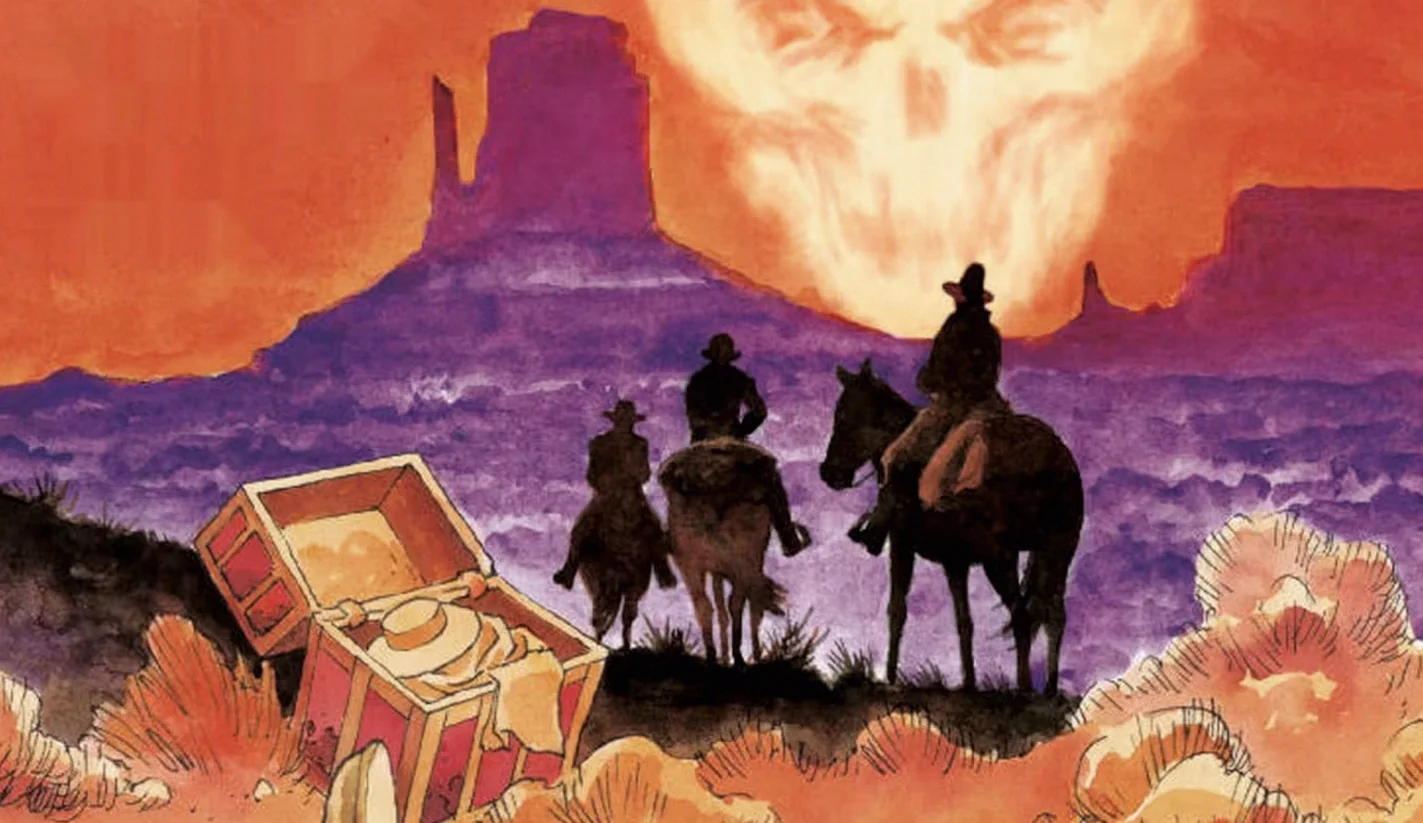
Risso’s approach here also includes a key stylistic shift. Known for stark black contrasts and lighting dominated by shadow in earlier work, he adopts a more painterly method for this book. He applies color himself with an effect close to watercolor, and the palette—frequently dominated by ochres, yellows, and reds—softens contours without removing the intensity of the visuals.
That color strategy matters because it changes the atmosphere. Instead of the more enclosed, urban feel seen in “100 balas,” the art foregrounds immensity. Risso uses the openness of the landscape to build spectacular compositions that recall classic western panoramas, while still keeping the grime, violence, and brutality demanded by Azzarello’s script.
Visual storytelling with minimal words
Risso’s command of visual narration is central to the reading experience. Many moments rely on little dialogue, using a glance, body language, or how figures are arranged within a panel to communicate emotion, danger, or shifts in power.
The overall effect is a visually stunning book filled with pages that emphasize the scale of the West—often reminiscent of the wide-screen framing associated with John Ford’s cinema. Risso’s work earned him his fifth Eisner award in 2025, and “La madre de los hermanos Blood” is positioned as one of his standout recent graphic achievements.
Brutal, pessimistic, and ambitious—collected as a full integral
While it may not be expected to match the historical influence of “100 balas,” “La madre de los hermanos Blood” demonstrates that Azzarello and Risso can take nearly any genre and make it feel unmistakably theirs. The hardcover release packages the original four-part run into a single integral volume, and includes additional materials such as removed pages, sketches, and illustrations by notable creators.