Christopher Nolan Defends The Odyssey’s Modern Look Against “Cultural Prejudice
Christopher Nolan is defending the artistic choices behind The Odyssey by arguing that “ancient” storytelling doesn’t have to come with a preloaded, overly formal presentation. In recent remarks, the filmmaker said his aim was to make the film feel “very fresh for modern audiences” while also steering away from what he called the “cultural prejudices” that can shape how people imagine the distant past.
Why Nolan thinks modern audiences need a different kind of “ancient”
In an interview with Channel 4 host Krishnan Guru-Murthy, Nolan addressed a recurring expectation around historical epics: that they should sound grand, distant, and stiff. Instead, he pushed toward a world that feels grounded and immediately usable for viewers today.
That argument also ties into how Nolan frames the source material itself. He described a gap between the way people talk about the ancient world and what the earliest evidence actually supports. Rather than treating the past as a single, polished aesthetic, he said he wanted to strip away assumptions that don’t hold up logically.
His core point is that the ancient setting is often “elevat[ed] because it’s old,” not because the approach is inherently accurate. Nolan claimed that when you look at Homer’s poem, you find something “earthy,” “grounded,” and accessible. From there, he says the film’s world-building was designed to keep the story vital and credible, rather than turning it into museum theater.
Nolan also described how people often lean on visual shorthand from the Romantic period—paintings where figures wear minimal clothing and wrap themselves in bed-sheet-like fabric, plus classical architecture that doesn’t match the Mycenaean era. In his view, that sort of look can become a lazy substitute for research.
To avoid that, he said the production went back to archaeology: what the material record can suggest, what it can’t, and how earlier portrayals handled the material. The goal, as he put it, was to build a consistent world that feels exciting to inhabit, not just impressive to look at.
“My dad is coming home” and the debate over historical accuracy
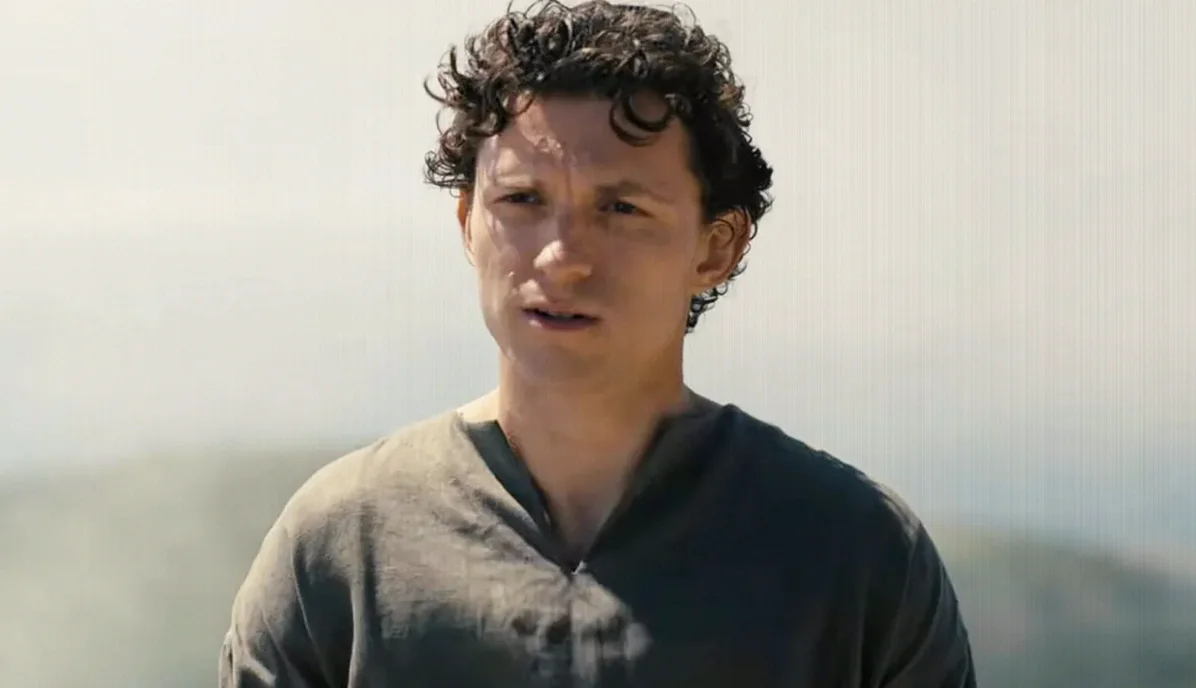
The Odyssey has already sparked online argument around one line of dialogue. Spider-Man star Tom Holland plays Telemachus, the son of Odysseus (played by Matt Damon). In the film, Telemachus tells Antinous (played by Robert Pattinson) that “my dad is coming home.”
Some critics see the phrase as an anachronism and question whether it fits the setting of a Greek epic. But Nolan’s broader defense is that The Odyssey isn’t a documentary-style recreation anyway. He describes it as a “mythic action epic,” packed with elements like a giant one-eyed monster and enchanting bird-women whose songs lure sailors to their deaths on rocky shores. In that context, the film’s job isn’t to chase strict historical speech patterns—it’s to translate myth into something playable and persuasive for a contemporary audience.
When Guru-Murthy asked Holland about the “dad” line directly, the actor responded with a short, practical justification: “Because I wouldn’t have even said ‘Father’ back in the day, would I? I would be Greek, so it’s no less correct.”
Key player-facing takeaway
- The “modern” wording is being defended as a choice meant to keep the story emotionally direct, not as a claim of exact ancient phrasing.
- Nolan’s defense leans on the idea that the myth’s tone—monsters, enchantment, and action—matters more than strict linguistic realism.
Language, casting, and the attempt to make the past feel familiar
In separate comments reported from an interview with the Los Angeles Times, Nolan said he wanted to find “language that has emotional not intellectual meaning” for audiences. The implication is that artificially elevated speech can create distance, even when the story is meant to feel intimate and immediate. He also admitted he might be wrong—saying it could “bite me on the ass”—but argued for the choice anyway because he wanted an “earthy narrative.”
Nolan also linked the film’s casting approach to that accessibility. In his view, using recognizable contemporary faces for legendary figures can act as a bridge for modern viewers. He pointed to examples including Lupita Nyong’o as Helen of Troy, Jon Bernthal as Sparta’s King Menelaus, and Zendaya as the goddess Athena. Nolan said these are “mythological figures” that are iconic, and that he wanted to “cast it big” by bringing in “the finest bunch of actors.”
The reasoning, as he framed it, is that audiences may settle in faster when they recognize the performers, even if the story is set in a far older world.
Armor, blackened bronze, and the “best speculation” philosophy
The Odyssey has faced more than just dialogue scrutiny. Nolan previously responded to concerns about historical accuracy after some viewers joked that Agamemnon’s armor resembles Batman’s. The conversation ramped up after the debut trailer showed Agamemnon in an intimidating all-black look, with one commenter quipping that they “had no idea Ancient Greeks used Batman helmets and sailed in Viking ships,” adding the question of why the film wouldn’t simply match what the “real thing” looked like.
In a Time magazine profile, Nolan argued that the movie’s setting—at the end of the Bronze Age, during a period of societal collapse in the Mediterranean basin in the late 13th to early 12th century BC—doesn’t come with complete certainty. He said what we know about that era is based on “very fragmentary archeological records,” and he maintained that the armor design in the film is still plausible.
His explanation focused on materials. Nolan said there are Mycenaean daggers made from blackened bronze, and that the theory is they could have blackened bronze by adding gold and silver to the metal and then using sulfur. He also credited costume designer Ellen [Mirojnick] with designing Agamemnon’s look to communicate status—making him appear elevated compared to others—by relying on materials that would have been expensive.
Nolan also addressed how to interpret Homeric portrayals. He said Homeric characters were first depicted “in the manner of people living in Homer’s time,” roughly 400 to 500 years after the collapse of the Late Bronze Age. In his view, that timeline gives a strong basis for representing elements in that way because it reflects how the first audiences received the story.
He then drew a parallel to his 2014 film Interstellar. That movie used real-world science to help predict and depict interactions with black holes, and it too drew complaints from some viewers about scientific accuracy. Nolan’s response to the Interstellar criticism, and his philosophy here, is that speculation has a purpose.
When discussing Interstellar, he said the framing is about “the best speculation of the future.” For an ancient past setting, he argued it’s comparable: “What is the best speculation and how can I use that to create a world?” He also said that even if people don’t agree with every choice, the film should still be enjoyable—and that he doesn’t want viewers to believe the filmmakers approached the project “frivolously.”
Release date and what to watch for when it lands
The Odyssey is scheduled to hit theaters on July 17, 2026.