Premier League 2026-27 Kits Ranked: Sunderland’s Elvis Shirt Tops the List
The 2026-27 Premier League campaign begins a week later than planned following the summer’s FIFA World Cup, giving clubs additional time to complete their kit launches. All 20 sides have now revealed a wide mix of heritage tributes, civic references and experimental designs, with Sunderland’s Elvis Presley-inspired away shirt emerging as the standout in the season’s 57-shirt ranking.
Several of the division’s biggest clubs unveiled their new ranges before the end of last season, including Arsenal, Chelsea, Liverpool, Manchester City, Manchester United and Tottenham Hotspur. The most successful designs have generally looked to club history without simply reproducing old shirts, while a number of the lower-ranked releases have been criticised for generic templates or overly busy graphics.
Sunderland lead the way
Sunderland’s pink-and-black away kit takes first place after drawing on Elvis Presley’s suit from his 1954 appearance on the “Louisiana Hayride” television programme. The design follows the adoption of “Can’t Help Falling in Love” as the club’s pre-match anthem at the Stadium of Light.
The newly promoted club have also produced a strong home shirt, ranked 13th, in tribute to their 1937 FA Cup winners. Its button collar, shielded crest and internal print naming the Wembley starting XI provide direct references to that side. Sunderland’s third kit, meanwhile, is based on the long history of stained-glass production along the River Wear, using crest-derived glasswork graphics and copper-coloured details.
Aston Villa’s restrained claret-and-blue home kit finished second. The Adidas design uses only the club’s principal colours, with a faux collar placket adding a vintage feel without tying the shirt to one specific period. Liverpool’s home shirt completes the top three, revisiting the triangular pattern associated with the club’s 1989-91 “Candy” era.
The top 10 kits
| Rank | Club and kit | Key design reference |
|---|---|---|
| 1 | Sunderland away | Elvis Presley’s 1954 “Louisiana Hayride” suit, in pink and black. |
| 2 | Aston Villa home | Minimal claret-and-blue retro styling with a faux placket. |
| 3 | Liverpool home | A modern version of the 1989-91 “Candy” shirt. |
| 4 | Tottenham Hotspur third | Mid-1990s purple Spurs strips, with a fold-over button collar. |
| 5 | Manchester United away | Late-1980s blue change-kit colours and retro detailing. |
| 6 | Leeds United away | Deep yellow with a Yorkshire rose pattern, black trim and heritage badges. |
| 7 | Hull City home | A vintage interpretation of the 1978-79 shirt. |
| 8 | Coventry City home | Blue-and-white stripes inspired by the 1986-87 FA Cup-winning side. |
| 9 | Tottenham Hotspur away | Dark navy with purple, pink and orange jagged bands. |
| 10 | Crystal Palace home | A white shirt with red-and-blue sash, recalling the 1970s and 1980s. |
Heritage dominates Liverpool, United and Arsenal ranges
Liverpool’s Adidas collection is heavily rooted in the 1980s. The away shirt returns to the white-and-red look used between 1985 and 1988, featuring a trefoil, oversized V-neck, historic crest and a subtle LFC pattern inspired by old Anfield ticket printing. The European third shirt is black with a maroon abstract graphic and matte-silver applications intended to stand out under floodlights.
Manchester United’s home kit marks 50 years since the 1977 FA Cup final victory, with a polo collar and cuff bands giving the otherwise clean shirt a traditional finish. Their ivory, maroon and deep-green third kit references Manchester youth institutions, including Salford Lads and Girls Club, and has a faint Lancashire rose woven into the material.
Arsenal’s home shirt was introduced in mid-May and worn as the club lifted the Premier League trophy before the UEFA Champions League final against Paris Saint-Germain. It commemorates 20 years at Emirates Stadium. The Gunners’ third shirt combines a yellow base with a cannon badge and lightning pattern, while the away design revisits the familiar “bruised banana” theme, this time with blue zig-zags.
Chelsea’s two Nike releases sit much lower in the ranking. The home jersey, unveiled in early June, has yellow details and a large lion graphic worked into the blue fabric. The away shirt uses laurel-inspired decoration around its collar and cuffs.
Manchester clubs take contrasting routes
Manchester City’s home shirt begins the post-Pep Guardiola era with a sky-blue-to-white gradient intended to represent the different blues worn across the club’s 140-year history, alongside early 20th-century white strips. The away kit uses Manchester’s worker-bee emblem, placing a bee pattern across a black-and-yellow base.
City’s third kit is one of the season’s more unusual launches. It was created by a supporter using Puma’s AI Creator platform during a club challenge, producing a plain white shirt with a blue central stripe.
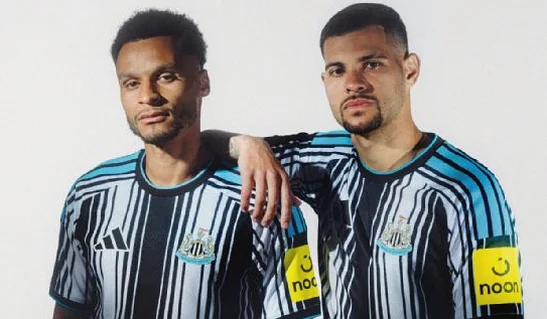
Newcastle United have used black-and-white stripes at home but added a visual Doppler-style treatment and bright-blue sleeve elements. Their away strip is blue-grey with a block graphic based on the crenellations of Newcastle Castle and includes a vintage crest. The club’s third shirt is its first lilac kit, with deep-violet trim.
Promoted teams lean into local identity
Coventry City return to the Premier League after 25 years away. Their home kit departs from a conventional sky-blue base in favour of blue-and-white stripes inspired by the Hummel shirt worn during the 1986-87 FA Cup triumph. The oatmeal-coloured away design has orange and navy trim with a jacquard finish, while the purple third shirt carries a rippling speckled pattern.
Hull City’s three Oxen kits all draw from older club designs. The home shirt references 1978-79, replacing the tiger-print promotion shirt with a more traditional amber look. The away kit recalls the 1988-90 strip, including its central badge and broad orange-and-black shoulder panels. Hull’s third jersey goes back further still, recreating the club’s 1935-36 civic-colour shirt, with an oversized badge and three crowns from Kingston upon Hull’s coat of arms.
Ipswich Town’s royal-blue home shirt has a repeating diamond texture influenced by the structure supporting the Portman Road floodlights. Ed Sheeran is no longer the main shirt sponsor, although his logo remains on the upper sleeve. The cream away shirt updates the club’s 1996-98 alternative kit through finer dual-tone pinstripes.
Leeds United’s home kit marks 400 years since King Charles I granted the Leeds Town Charter in 1626, using yellow and blue horizontal pinstripes on white. The third kit turns to the city’s industrial past, with a dark graphite pattern made from fragments of local buildings, structures and materials.
Other notable releases
- Aston Villa’s black away shirt honours the Founding Lamp outside Villa Park, with a flame-like pattern and gold, claret and sky-blue trim. Its third kit uses a scroll pattern taken from the Holte End mosaic installed in 2007.
- Brentford will retain their home kit for two seasons, continuing a policy that means the red-and-white striped shirt will run from 2026 to 2028. Its yellow trim references the worker bee in the club crest. The navy away design was influenced by the “Kingsman” films after director and 2025 minority shareholder Matthew Vaughn became involved with the club.
- Bournemouth’s home shirt accompanies the club’s first European campaign and uses a retro-inspired format. The lavender away kit updates a zig-zag design from the early 1990s, while the cream, black and gold third shirt is disrupted by a large pink sponsor panel.
- Crystal Palace have switched their primary look to white with a red-and-blue sash and matching sleeve treatment. A red-and-blue striped alternate shirt, described as a “home away from home” strip, uses a hand-drawn feather motif. The separate Black Eagle design is black with asymmetrical red-and-blue trim and embossed feather detailing.
- Everton’s home kit is royal blue with amber-yellow flashes at the collar and sleeves, linked to the Docklands setting of the club’s new home. The white away shirt uses fine navy and yellow pinstripes inspired by a 1950s design, while the khaki third strip echoes the orange-accented Umbro shirt from 2015-16.
- Fulham’s white home shirt keeps the usual black-and-red details and adds diagonal ribbing intended to represent the Thames beside Craven Cottage. The away kit revisits the red-and-black checkerboard worn in 1996-97, when the club won promotion from the fourth tier, while the third is pale blue and pink with striking bright-pink trim.
- Nottingham Forest’s away kit takes a direct “forest” theme through dark green fabric, leaf-pattern detailing and bright-red accents. The sky-blue and white third shirt uses a ripple effect intended to evoke the River Trent. Their home design also references the river, with a mottled effect said to represent mist rolling in around the City Ground.
- Brighton & Hove Albion’s home shirt is based on the blue-and-white kit worn in the 1982-83 FA Cup final. The away version reverses those pinstripe colours, while the teal-and-turquoise third shirt is inspired by Brighton Pier and the sea after dark.
Lowest-ranked shirts
Newcastle’s home kit was placed last, largely because of its distorted stripe effect and oversized blue sleeve stripes. Nottingham Forest’s mist-inspired home shirt followed in 56th, ahead of Fulham’s understated home release.
Manchester City’s supporter-designed AI third kit came in 54th, while Coventry’s purple third shirt ranked 53rd. The bottom end of the list also included Palace’s feather-patterned red-and-blue alternate shirt, Everton’s plain home kit, Brighton’s reversed-pinstripe away shirt and Chelsea’s home design.
At the other end, the strongest collection is built around recognisable club references: Sunderland’s music-linked tribute, Villa’s elegant two-colour home shirt, Liverpool’s late-1980s revival and Tottenham’s mid-1990s-inspired third kit. With the new season now under way, those designs will soon move from launch campaigns to Premier League matchdays.